
Getting Rush County Court Records
Start with Indiana MyCase to locate the Rush County case number and event. Some nonconfidential orders have public links. For an official file, missing document, or certification, contact Rush County Clerk Jennifer Sammons. The unified office keeps records for Rush Circuit and Rush Superior courts.
Visit Room 209 at 101 E. 2nd Street, Rushville, or call 765-932-2086 for hours, copy methods, fees, payment, identification, and mail instructions. No universal email or fax route for record requests was published. Court-specific setting questions can go to Circuit at 765-932-2078 or Superior at 765-932-3520.
- Identify the AR8 case number and Rush court.
- Note the exact event, document title, and date.
- Choose online inspection, counter service, phone routing, or confirmed mail service.
- Ask whether the copy must be plain, certified, or exemplified.
- Confirm fee, payment, postage, ID, and turnaround before sending funds.
Rush Docket, Document, or Copy
Three products often get called a court record. The chronological case summary is the dated event list. A filed document is the petition, motion, exhibit, order, or judgment behind an event. A certified copy is an allowed record authenticated by the Clerk. A MyCase printout is not certified.
- Docket
- Public event and setting history.
- Filed document
- The image or paper associated with an event.
- Certified copy
- A clerk-authenticated official copy.
A reader tracking a hearing may need only the Rush County docket. Someone who must present an order elsewhere should ask the recipient if certification is required.
Rush County Court Record Types
Rush County files can include complaints, petitions, motions, responses, orders, judgments, notices, chronological case summaries, and nonconfidential exhibits. Civil tort, plenary, foreclosure, miscellaneous civil, and collection matters may expose nonconfidential documents online. Criminal categories generally show sentencing orders online while other public documents may require inspection.
Estates, guardianships, evictions, small claims, infractions, red-flag matters, and trusts often show public orders but not every filing. Family, adoption, juvenile, mental-health, and protection-order material carries stronger limits. A missing link does not mean a filing is absent.
- Case summaries with dates, events, settings, and status
- Pleadings such as complaints, petitions, motions, and responses
- Signed orders, judgments, and sentencing orders
- Nonconfidential exhibits subject to retention rules
- Transcripts ordered from the court reporter
Rush MyCase Access Matrix
The official access matrix separates documents visible online from public material available at the Clerk. Public access and remote access are not equal.
| Record group | Online | At Clerk |
|---|---|---|
| Civil tort, plenary, foreclosure | Nonconfidential documents | Allowed file material |
| Felony and misdemeanor | Sentencing orders | Other nonconfidential documents |
| Family | No documents | Nonconfidential material in person |
| Juvenile and mental health | No public access | No public access under matrix |
Rule 5 restrictions still control each Rush County record. The Clerk remains the source for the official file.
Inside a Rush County Court Record
A case summary organizes the header, parties, attorneys, events, hearings, case-specific charges or civil categories, public documents, financial entries, disposition, and related cases. Match the court, case number, event date, and title before requesting a paper.
| Case Number | Rush court, filing month, type, and sequence |
|---|---|
| Pleadings | Petitions, motions, answers, and responses |
| Orders & Judgments | Signed rulings and final entries |
| Case Summary | Chronological public event list |
| Exhibits | Evidence governed by access and retention rules |
Room 209 Official Copy Route
The Rush County Clerk counter is the local official-copy route. Give the case number, court, event title, and date. Ask whether a file is on a public terminal or must be pulled by staff.
Rush County Clerk
101 E. 2nd Street, Room 209
Rushville, IN 46173
765-932-2086
Records, copies, certification, and official balances for both Rush courts.
The official record-request route appears below.
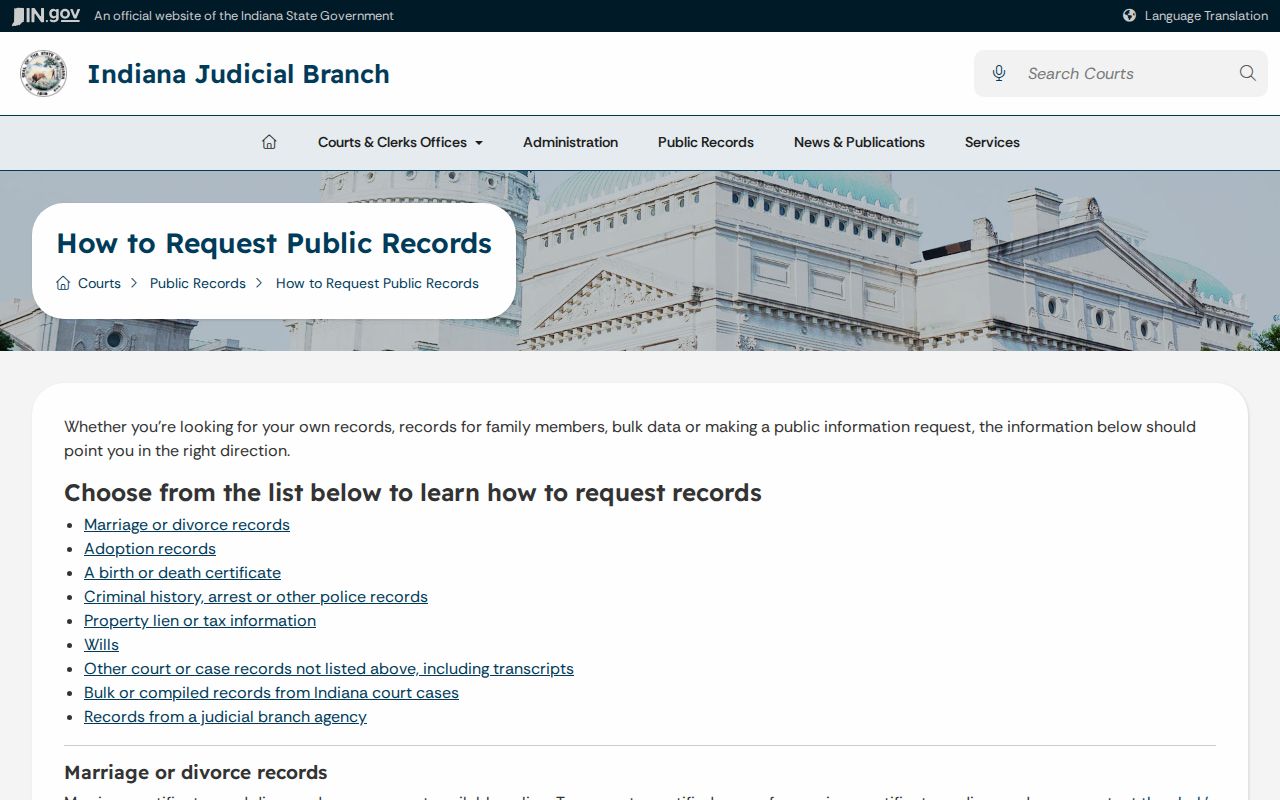
The source sends case-document requests to the clerk where the case was heard.
Fees and Certified Copies
A certified Rush County court record bears the Clerk's authentication. An exemplified record adds formal authentication. No current Rush plain-copy, certified-copy, exemplification, search, or online-image price was located. Confirm every amount with the Clerk.
| Item | Amount |
|---|---|
| Plain copy | Ask Clerk |
| Certified copy | Ask Clerk |
| Exemplified record | Ask Clerk |
| Transcript original | Up to $4.25 per page |
| Transcript copy | $1.25 per page |
Rush Transcript Rate Limits
The Clerk keeps the written file, but the court reporter creates a transcript. Rush local rules cap a non-indigent original at $4.25 per page and a copy at $1.25 per page. They also address a $35 small-transcript minimum, binding time, and supplies. Those are reporter rates, not Clerk copy prices.
The trial-court fee source appears in the assigned image.
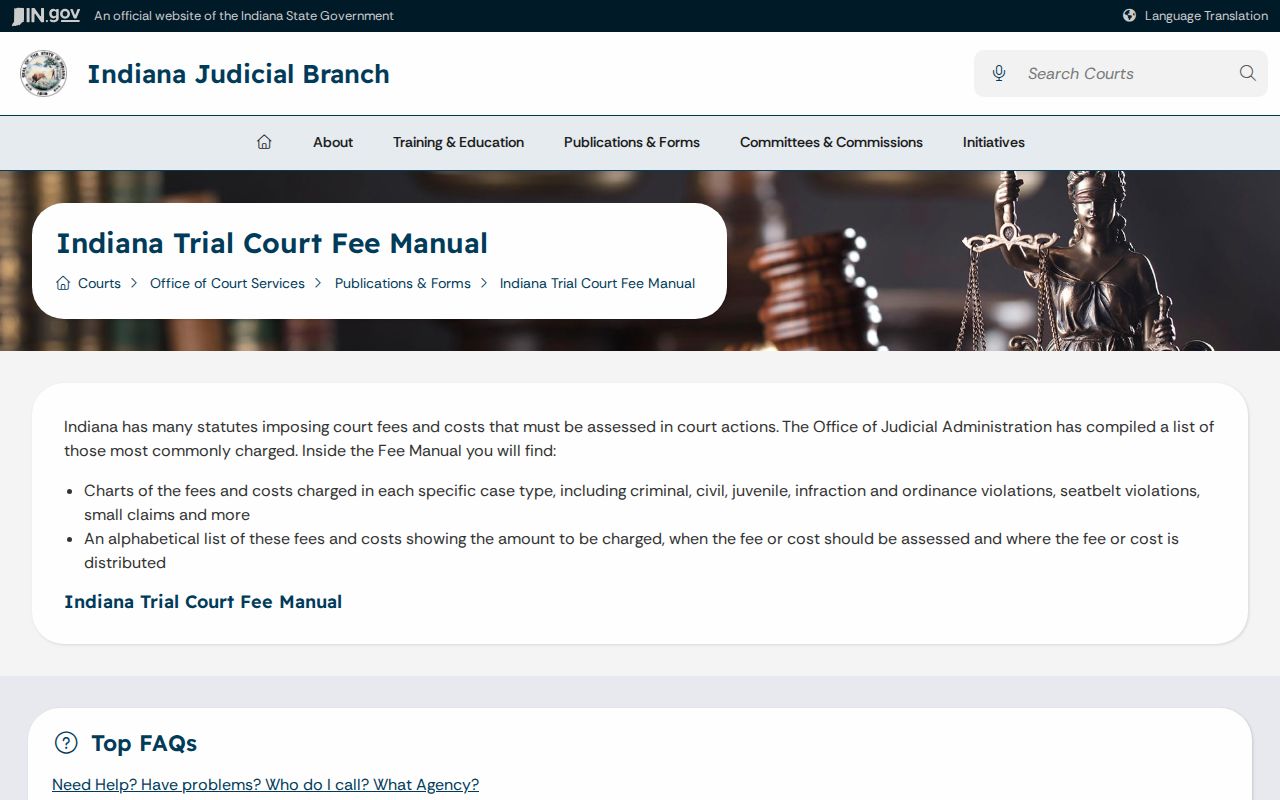
It is a statewide source, so the current Rush copy charge still needs Clerk confirmation.
Sealed Records and Public Access
Court Records Rule 4 begins with public access, while Rule 5 excludes sealed, confidential, medical, mental-health, juvenile, and other protected material. Complete account numbers and similar identifiers are masked.
Key Rules:
Rule 4 sets the public presumption. Rule 5 defines exclusions and redaction. Rule 9 provides a verified request route for excluded records. Administrative Rule 9 governs courthouse, calendar, and bulk access.
A routine copy request cannot override a seal. Rule 9 may require notice, responses, a hearing, and a written order. The assigned image shows that court process.
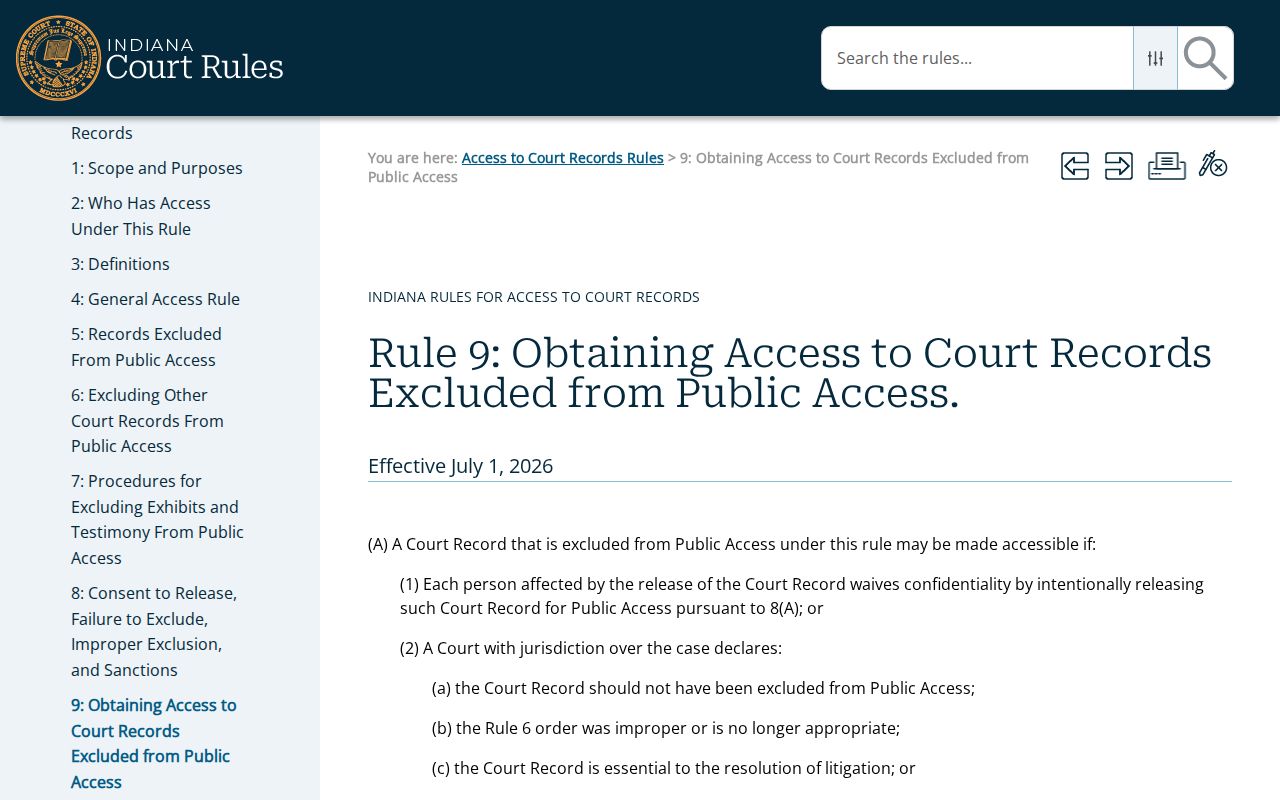
The record stays confidential while the court decides.
Rush Historical and Bulk Records
The Indiana State Library Rush guide lists court records from 1822 through 1857 and identifies the Clerk as original custodian. Give the approximate year, court, type, party names, and case number when known. Those details help staff distinguish an early paper volume from a current electronic Rush County court record. The Clerk can determine whether the file remains at the courthouse, was archived, was microfilmed, or has reached a retention limit.
Exhibits have their own timelines. Current Rush local rules generally retain noncriminal exhibits for four months after decision unless an appeal changes the period. Misdemeanor and Level 6 or attempt records have a three-year period, while Level 1 through Level 5 records have a twenty-year period. Murder and life-sentence material follows special rules. Retention does not mean the exhibit is public or downloadable. Access limits still apply.
Bulk case data goes to IOCS/OJA under Administrative Rule 9, not through repeated MyCase searches. The official bulk-data page appears below.
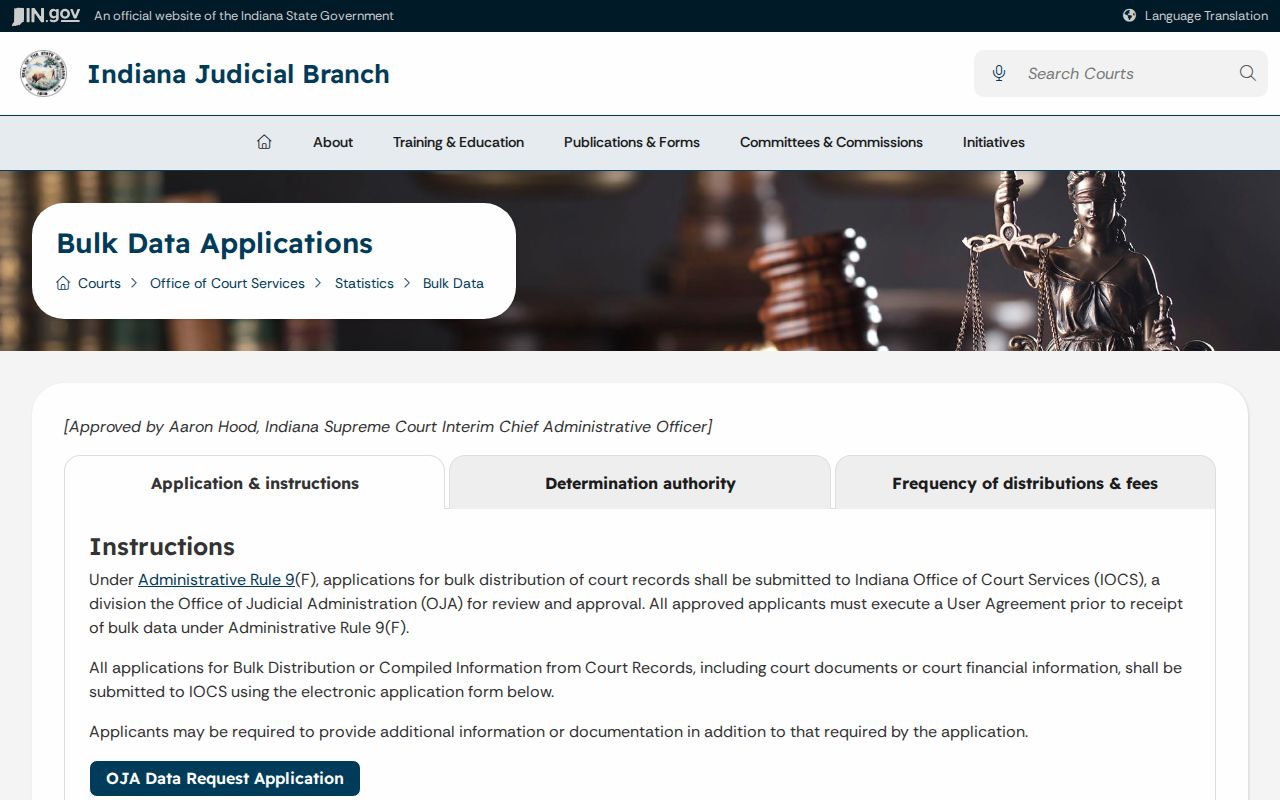
Compiled-data fees are separate from local copy charges. The published IOCS schedule includes different per-case prices for recurring open, new, and closed data, plus an hourly price for one-time work. None is a Rush County Clerk plain-copy rate.
Indiana e-filing is also distinct from public access. The assigned Tyler INcourts provider image shows one filing route.
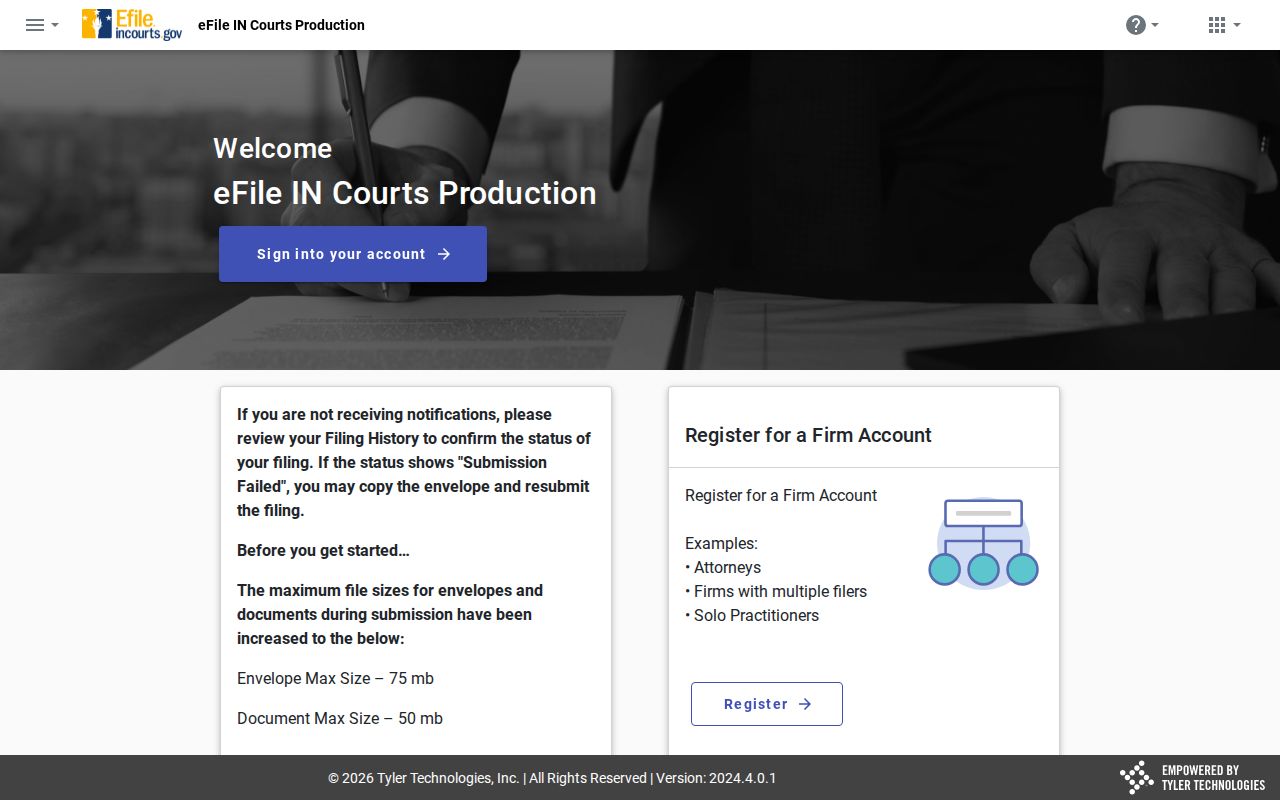
A filing account submits papers; MyCase and the Clerk provide docket and record access. Rush local rules allow a self-represented filer to use the state e-filing system, deliver a filing in person, or use the listed filing fax. That filing permission does not establish the same fax as a general public-copy request route.
Rush APRA Response Timing
The Indiana Access to Public Records Act distinguishes an initial response from production. An in-person or telephone request generally receives a response within twenty-four hours. A written request sent by mail, fax, or email generally receives a response within seven days. The record itself must then be produced in a reasonable time based on scope and circumstances.
Those rules do not promise same-day delivery, and they do not make excluded court records public. A useful Rush County request identifies the exact court, AR8 number, event or document, date range, and preferred format. If an agency denies a public-record request, the Indiana Public Access Counselor can address an APRA complaint. A dispute over access to an excluded court-file document uses Rule 9 instead.