
Searching Rush County Criminal Dockets
Indiana MyCase offers free, statewide access to public Rush County criminal docket information. Case works when you know a case, citation, or cross-reference number. Party takes a person’s name. Attorney takes counsel’s name or bar number. Choose Rush County to limit results to the local courts. Pick the Criminal and Citation category to cut noise when you already know the case type.
A case number is the strongest key. Rush Circuit Court files open with 70C01, and Rush Superior Court files open with 70D01. Next come the filing year and month. Then comes a type code such as CM or F1 through F6, then a six-character sequence. Broad name searches go better with a status or filing date added. Repeated searches can trigger a CAPTCHA. Skip past it by using the clerk fallback rather than trying to bypass it.
- Choose Case, Party, or Attorney in MyCase.
- Select Rush County and Criminal and Citation.
- Match court code, case style, file date, and status.
- Open the summary and read newest events first.
- Ask the clerk for an official copy when needed.
Rush Criminal Court Codes
In an Indiana case number, the first group identifies the court, not the offense. Administrative Rule 8 assigns county code 70 to Rush, letter C for Circuit, and letter D for Superior. A transfer can rewrite that first group while keeping the sequence, so check the related and cross-reference fields whenever a familiar number comes up empty.
The type codes describe the file. CM means misdemeanor, F1 through F6 mark current felony levels, and CF shows up on older felony numbers. MC is miscellaneous criminal. RF flags a red-flag case. None of these codes state guilt, sentence, or outcome.
- 70C01
- Rush Circuit Court’s Odyssey identifier.
- 70D01
- Rush Superior Court’s Odyssey identifier.
- Disposition
- The court-entered outcome, distinct from the charge.
Note: When a transfer or an uncertain assignment muddies the first number group, search both local identifiers.
Inside a Rush County Criminal Docket
A Rush County chronological case summary opens with the court, case number, filing date, type, status, style, and status date. Public roles may name the state, the defendant, attorneys, and others. Charges can carry an offense date, statute, degree, original degree, or modification. Bond information sits in its own block with an amount and history. That money secures release. It is not fines or costs.
| Case header | Court, file date, type, style, status, and status date. |
|---|---|
| Charges | Filed allegations, statute, level, and modifications. |
| Events | Hearings, motions, orders, pleas, sentencing, and appeals. |
| Financials | Fees, fines, transactions, and a balance that may lag. |
| Disposition | The outcome, read apart from the filed charges. |
The summary may also list related cases, cross-references, documents, and masked indicators. Treat it as a public view rather than a certified file. Match the newest entry against the status date and any linked order.
Rush Charges, Bonds, and Outcomes
Three docket blocks answer three different questions. A charge says what was filed. A bond entry describes the security for release plus later bond events. A disposition records what the court actually did. Stop at the charge line and an allegation can morph into a false claim about the result.
Read the newest events first. Then return to the charges to see whether an offense changed. A plea, dismissal, bench result, jury result, or sentencing entry adds context. “Closed” is an administrative status, and later review activity can still follow it. Quote the portal wording exactly rather than guessing.
Key distinction: A filed charge is not a conviction, and a bond amount is not a fine. Disposition and sentencing entries describe the result.
How a Criminal Case Moves
A Rush County criminal docket grows entry by entry. Each filing and court act is recorded. Initial process may show up as a filing, charge, summons, warrant, or initial appearance. Later entries can include arraignment, pretrial settings, motions, plea, trial, disposition, sentencing, and review. No case hits every step.
Docket flow: Filing › Arraignment › Pretrial › Plea or Trial › Disposition › Sentencing
One continuance can string a motion, a proposed order, an entered order, and a new setting into a single chronology. Read the dates in order. An old hearing does not stay current just because its entry sits on screen. The Rush County court dates page lays out the full confirmation chain.
Rush Criminal Filings in 2024
The Indiana trial-court statistics system counted 681 new criminal filings across Rush courts in 2024. Misdemeanors made up 363 of them. The rest broke down as F6 161, miscellaneous criminal 103, F5 36, F4 8, F3 4, F2 2, post-conviction 3, and red flag 1.
These are administration counts. They are not a list of people or a pending-case total. Circuit’s detailed categories showed 365 filings and Superior’s 316, and report structure can explain differences among views. Never count disposition events as separate new cases.
Courts That Hold Criminal Dockets
Rush County runs one Circuit Court and one co-equal Superior Court. Under current local rules, criminal cases with material drug or alcohol elements land in Superior. Everything else criminal goes to Circuit. That split is why cases at the same offense level can carry different court identifiers.
The official Rush County courts page links the local rules, directory, MyCase, and statistics. Circuit answers setting questions at 765-932-2078. Superior answers at 765-932-3520. The Rush County Clerk, in Room 209, 101 E. 2nd Street, Rushville, keeps both courts’ records. The Clerk handles copy or balance questions at 765-932-2086.
No separate municipal criminal court exists here. The county has built no felony portal of its own. A city office is not a criminal docket source.
Rush Sentencing Orders Online
A public event can appear in the docket without the paper behind it. Under the MyCase document-access matrix, public CF, CM, and F1 through F6 cases generally offer sentencing orders online. Other nonconfidential criminal papers generally come from the clerk in person.
The official MyCase criminal search shows this system at work.
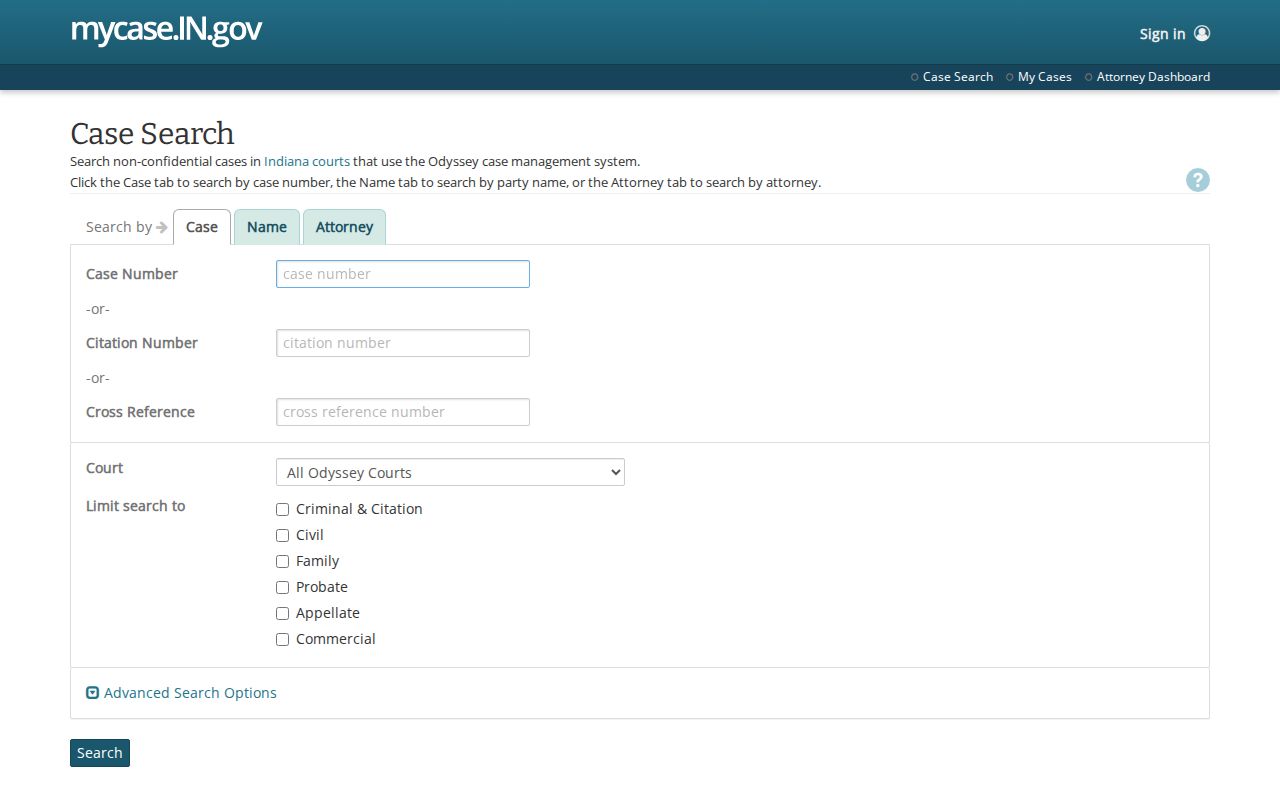
The statewide sheet sets the baseline for a Rush County sentence, yet the clerk's office is where you obtain permitted papers, since no public link to them exists online.
A blank icon is not proof of nothing filed.
Sealed Dockets and Public Access
Public access is the default under Indiana Access Rule 4. The rule carves out exceptions. Sealed material stays closed. Identifiers, certain supervision records, medical records, and juvenile content are among the protected categories. So a Rush County docket result may display only a restricted marker instead of full case details.
The official text of Indiana Rule 5 lists these exclusions in full.
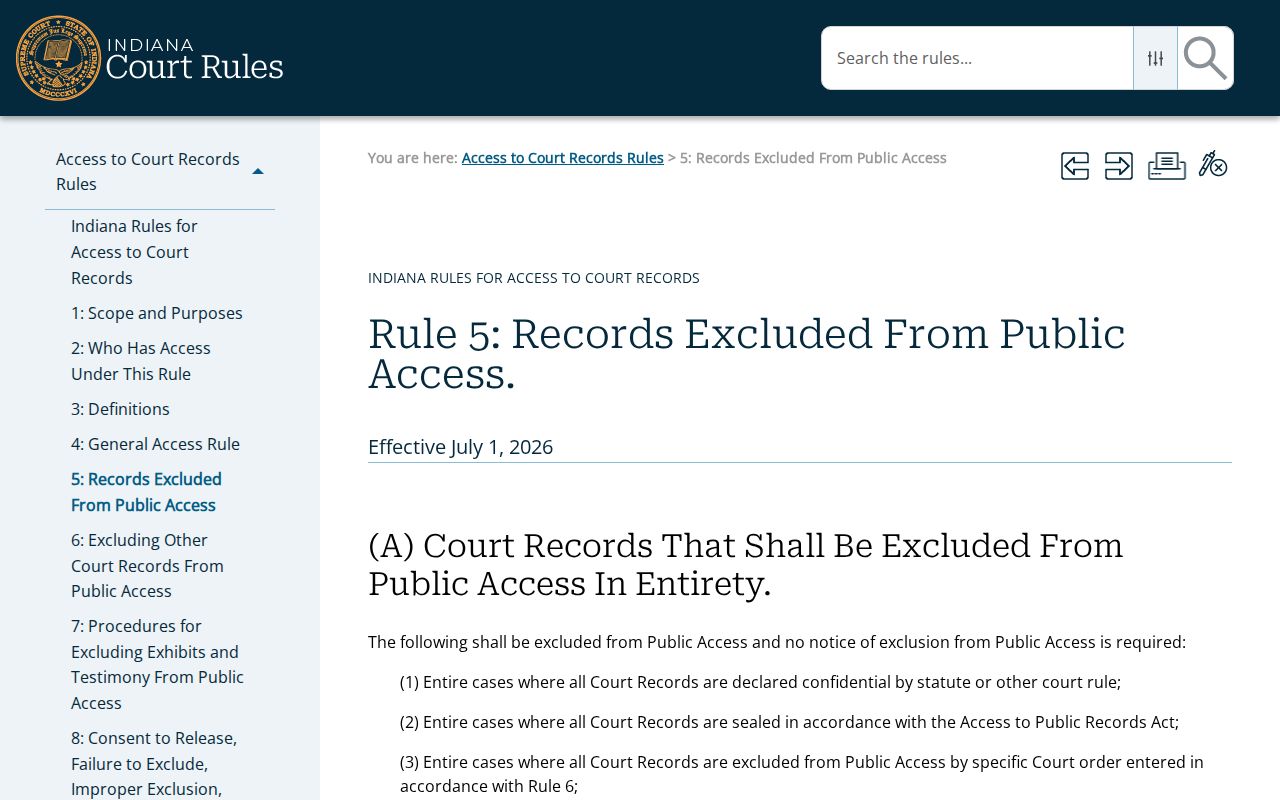
The rule explains why a visible case shell never grants access to protected content.
Access rule: Rule 9 supplies the court process for seeking access to an excluded record. The request stays confidential until the court rules.
Remote docket lookup runs through MyCase. The clerk's counter and public terminal serve anyone who comes in. Mail works too. Send requests to the clerk. The office publishes no general records email or fax, so confirm instructions before you mail funds or originals. Transcripts are a separate errand; the court reporter handles those.
Rush Clerk and Court Answers
Two offices split the workload. The Rush County clerk handles files, copies, certifications, and public terminals. The clerk also gives official balances due on a case. The court itself can confirm a current setting or courtroom detail. Neither one will give legal advice. If MyCase comes up empty, drop a category you are unsure of, or run both court codes. You can also search by citation and cross-reference before calling the clerk. Older cases and restricted record types do not always surface like current public ones. Want a certified order? Name the case and the paper, and ask the current fee. Then pay the clerk as instructed. One more thing: MyCase is state court only. Any federal criminal matter tied to Rush County has to be searched through the Southern District of Indiana and PACER.